
You have an outdated webbrowser. The website might not work correctly.
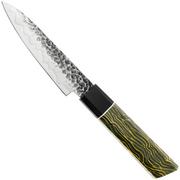
The petty knife is the Japanese version of the European paring knife. It is a small and practical knife that you use for all things where your chef's knife, gyuto or santoku is just too big. This knife is great when peeling vegetables and fruit, but can also be used for other small tasks in the kitchen. You use the pointed tip for more precise tasks. Petty is the common name for this type of knife in Europe, but in Japan they often call this type of knife ''shotoh''.


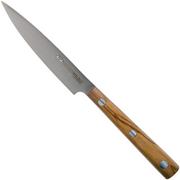


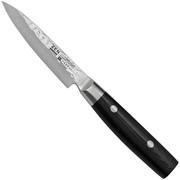


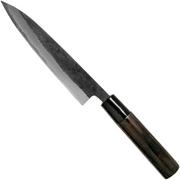


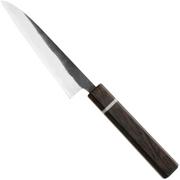

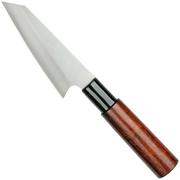


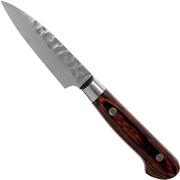


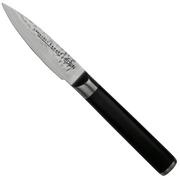


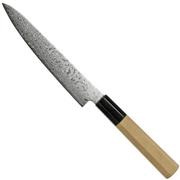

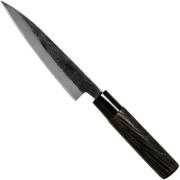

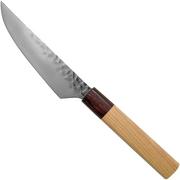

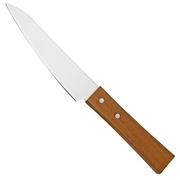

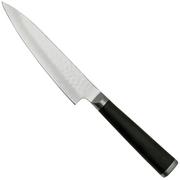


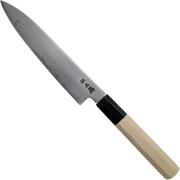

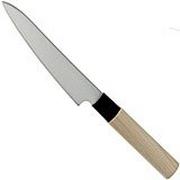

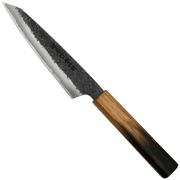

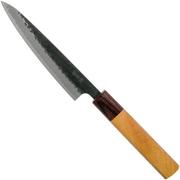

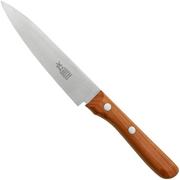

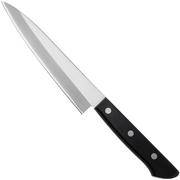


Unlike European paring knives, the blade length of a petty knife can vary quite a bit. You can find petty knives with a blade length of 8 cm, and ones that are as long as 15 cm. That's much more variety than the 7-10 cm blade length we usually see on paring knives.
Choosing the best petty knife for you mainly depends on the blade length. Most importantly, your petty should complement your chef's knife, santoku or gyuto. Are you using a santoku with a blade length of 18 cm? Then a petty with a blade length 14 cm will not add many more cutting options for you. In this case, it's better to choose a petty with a blade length of 9 or 10 cm for the more precise cutting tasks. However, is your favourite kitchen knife your 24 cm gyuto? Then a 15 cm petty knife will be a useful addition.
What is the difference between petty knife and paring knife? They are both compact, versatile kitchen knives designed for precision tasks. A petty knife is often considered the Japanese counterpart to the European paring knife and is ideal whenever a chef's knife, gyuto or santoku is simply too large. Both knives are well suited to peeling fruit and vegetables, trimming ingredients and other detailed kitchen tasks. One of the main differences is that a petty knife typically has a slightly longer, narrower blade, making it more versatile for slicing as well as precision work. In Japan, this type of knife is also commonly referred to as a shotoh knife.


